
Introduction:
Communication has become the lifeblood of our daily lives in today’s interconnected society. We rely on fast and dependable data transfer when browsing the internet, streaming videos, or making long-distance phone calls. The basic but amazing fibre optic cable is at the centre of this technological shift. In this blog, we will look at the wonders of fibre optic cables and how they have changed the way we communicate.
- What exactly are Fibre Optic Cables?
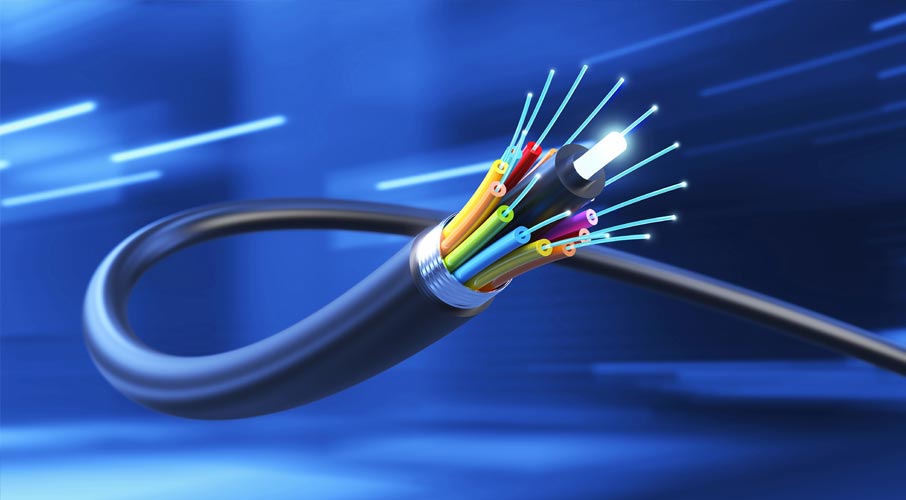
Fibre optic cables are small strands of glass or plastic, thinner than a human hair, that can carry data across large distances at the speed of light. Unlike typical copper wires, which utilise electrical impulses to transmit data, fibre optic cables use light pulses to transmit data. These cables are made up of a core, a cladding layer, and an outer protective jacket that ensures effective transmission while protecting the sensitive components. - Speed: One of the most impressive features of fibre optic cables is their extraordinary speed. These connections can carry massive volumes of data at breakneck speeds. Fibre optic connections can attain speeds of up to billions of bits per second by utilising the qualities of light, allowing for seamless and lag-free communication. Fibre optics provide unrivalled speed and dependability, whether you’re downloading enormous files or participating in real-time video conferencing.
- Interference Resistance: Another key feature of fibre optic cables is their resistance to electromagnetic interference. Traditional copper wires are susceptible to interference from a variety of sources, including electrical noise and radio waves, which can reduce signal quality. Fibre optics, on the other hand, are resistant to such disruptions. External variables have no effect on the light signals within the wires, providing clear and uninterrupted data transfer.
- Long-Distance Communication: Because fibre optic cables excel at long-distance communication, they are essential for global connectivity. Light exhibits minimal signal loss as it travels through the wire, allowing data to be sent over long distances without deterioration. This feature has transformed international telecommunications, allowing us to easily connect with individuals across continents and access information from all over the world.
- Bandwidth aplenty:
With the growing need for high-bandwidth applications, fibre optic cables provide the infrastructure required to support our data-hungry world. These cables have a massive bandwidth capacity, allowing for the simultaneous transmission of large amounts of data. Fibre optics will provide the backbone for future technologies such as cloud computing, virtual reality, and the Internet of Things (IoT) as technology progresses and our data requirements expand.
Conclusion:
Fibre optic cables have revolutionised communication, breaking down barriers and propelling us into the digital age. Fibre optics have become the backbone of our interconnected world due to their exceptional speed, resilience to interference, and capacity to carry data over large distances. As we continue to rely on technology for business, leisure, and communication, the importance of fibre optic cables in enabling smooth and efficient connection cannot be stressed. Their influence will only increase as we embrace the potential of a digitally connected future.